Power Supply Selection
It's essential to select the correct power supply for your specific application. If we could simply include a power supply in the box that would work for everyone we would do that. Because each user is using a different combination of devices, sensors, and sound setups, all which can dramatically affect the power required, the power supply selection is up to you.
Selecting the Voltage
First, you must confirm the allowable voltages by looking at the controller's label or specifications on the product's page. Most controllers will accept a range that includes 12 and 24 volts. 12 volts is by far the most common. 24 volts is often used in industrial settings or to get the most wattage out of the audio amplifier.
Below is an example of the voltage / power specs you'll find at the bottom of a product page:
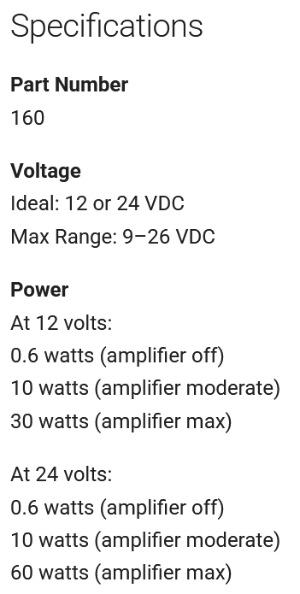
NOTE: Perceived loudness does not scale linearly with amplifier power. Even though the maximum audio output at 12 volts is half of that at 24 volts, it certainly does not sound like half. The difference is noticeable but not as dramatic as the watt numbers suggest. Combined with the prevalence of 12 V devices, 12 V remains the most common choice.
Solid-State Output Voltage
If your controller has solid-state outputs, be aware that the voltage of your power supply is what will come out of the solid-state outputs. For this reason, all the devices connected to the outputs must also be rated for 24 volts.
Calculating the Current / Wattage
To size the supply you must total up the power required by all the devices drawing power from it. In most cases this would be the controller itself, including the internal amplifier if used, plus all the outputs that will be on at any given time.
See the specifications on the product page to confirm the power required by the controller and the audio amplifier (if used).
If a device only lists it's power in amps, multiply that by the voltage to get watts. For example, 0.5 amps would be 12 watts at 24 volts.
What NOT to Include
When totalling up the power required, you would NOT include devices that are not powered by the supply. This would include:
- DMX devices
- High voltage AC devices that are switched by relay outputs.
- Devices controlled by relay outputs that do NOT borrow power from the controller's Power terminals.
Example Calculations
Below are a few calculations for different controller setups. As you can see, the sensor and controller take very little power and can almost be ignored. You primarily need to add up the audio amplifier and output devices borrowing from the supply.
PicoLite Example
This example consists of a PicoLite running on 12 volts with a step pad and one large solenoid.
| Device | Watts |
|---|---|
| PicoLite | 0.6 |
| Step pad | 0 |
| 1 x Large Solenoid | 18 |
| Total | 18.6 |
Choice: Note that a common 12V 1A (12 watt) supply will NOT work here. A 12V 2A (24 watt) would probably suffice.
PicoPro Example
This example consists of a PicoPro running on 24 volts to get about 50 watts out of the amplifier. There is also a motion sensor, a few 24V solenoids, and an LED light.
| Device | Watts |
|---|---|
| PicoPro | 0.6 |
| Internal Amp | 50 |
| Motion Sensor | 0.36 |
| 4 x 6w 24V solenoids | 24 |
| Total | 74.96 |
Choice: A 24 volt 5A (120 watt) supply is very common so we will use that here.
PicoDrive Example
This example consists of a PicoDrive running on 12 volts with a motion sensor, a wiper motor, and a fog machine. The internal amplifier will be used at moderate volume. Note that the fog machine is 0 watts because the PicoDrive's relay only triggers it, it does not power it.
| Device | Watts |
|---|---|
| PicoDrive | 0.6 |
| Internal Amp | 10 |
| Motion Sensor | 0.36 |
| Fog Machine | 0 |
| Wiper Motor (3.5A) | 42 |
| Total | 52.96 |
Choice: A 12 volt 5A (60 watt) supply would work here provided the wiper motor is not drive too hard.
Power Supply Overload
If your power supply is undersized it will likely overload occasionally. This will often happen during recording and is mistaken for a controller error when really it's because the power supply is undersized.
When this happens the power supply shuts down breifly and the controller loses power. You will likely see the controller's power LED flash, then the controller will blink it's LEDs the same way it does when it first powers up.
Depending on your setup, this may happen when a specifc output turns on, only when multiple outputs turn on, or only occasionally when outputs are on and the amp is working hard.
Please read the information above to learn how to choose the correct power supply for your application.
Short Circuits
If this is a new setup and you are sure the power supply is sized correctly, double-check your wiring. A short circuit in the output wiring will also reset the power supply in the same way.